A learner who builds
My path is shaped by study, experimentation and hands-on projects. I use each build to understand a system more deeply: how a user moves through it, how the interface communicates, and how the code supports the experience.

Home / About
The person behind the work.
I'm Anis Ramdani, the person building RG Technology. I study Software Engineering and Information Systems at Larbi Tebessi University in Tébessa, Algeria, while exploring the space where design, software and interaction meet.
RG Technology is my creative technology workspace: a place to turn ideas into interfaces, applications, tools and learning experiences — then explain how they were made.
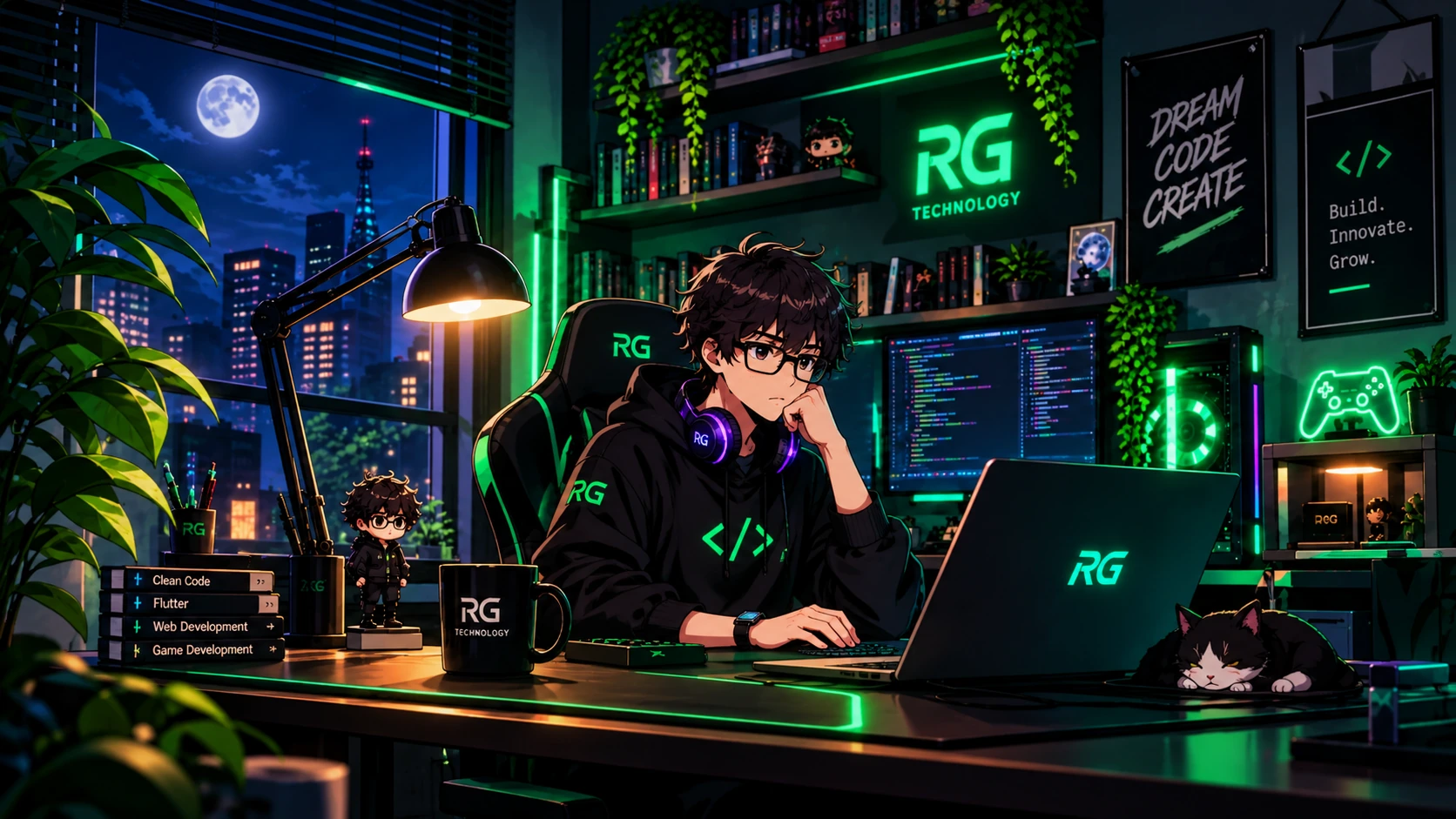
My path is shaped by study, experimentation and hands-on projects. I use each build to understand a system more deeply: how a user moves through it, how the interface communicates, and how the code supports the experience.
I enjoy working across frontend development, application ideas, UI/UX, animation, 3D experiments and practical software. The goal is not to collect technologies, but to choose the right ones for a useful result.
DREAM · BUILD · INNOVATE
Make technology feel less like a black box. Build digital experiences that are thoughtful and useful, and share practical ways to understand the process behind them.
RG Technology brings together three connected activities:
Rather than presenting an invented career timeline, this page focuses on the working approach visible across the projects and experiments in the RG Technology workspace: start with a question, sketch the idea, build a small version, test it and improve what matters.
My public profile lists Software Engineering and Information Systems studies at Larbi Tebessi University. That academic foundation sits alongside practical exploration and independent project work.
The portfolio includes learning-platform concepts, Arabic-first web experiences, interactive portfolio work, school-management software and an offline-first point-of-sale application. Each project demonstrates a different problem and set of trade-offs.
Sketches are working documents here: they help expose structure, explain a decision and make the next step visible. The final interface still has to be responsive, accessible and functional.
Good digital work should do its job clearly and feel considered while doing it. Visual polish cannot hide broken behavior; technical complexity is not valuable unless it solves a real need. I try to keep both sides in the same conversation.
A clear project, an early sketch or a question about the work — start with a short brief and we can see what makes sense.
Start a project